

Select Datamolino on Financial Administration
Recommended setup in Datamolino (trial, plan, DIČ pairing and token) plus shortcut when selecting on Finančná správa first.
Open selection guideSlovakia introduces mandatory structured e-invoicing via Peppol on 1 January 2027 under Act No. 385/2025 Coll. Here is who is covered, how Slovak Peppol IDs work and how to handle e-invoices alongside foreign PDFs and receipts.
Act No. 385/2025 Coll. (amending the Slovak VAT Act No. 222/2004 Coll.) creates two different obligations on 1 January 2027. Every taxable entity and legal person in Slovakia must be able to receive structured e-invoices, while domestic B2B and B2G issuing applies to Slovak-established VAT payers.
| Entity type | Must receive Peppol XML? | Must issue Peppol XML? | Notes |
|---|---|---|---|
| Slovak-established VAT payer (§ 4, § 4b, § 4c) | Yes, from 1 Jan 2027 | Yes, domestic B2B & B2G | B2C consumer sales and eKasa receipts up to €400 stay out of Peppol |
| Non-VAT payer (sole trader, small business, landlord with DIČ) | Yes, from 1 Jan 2027 | No (exempt until 30 Jun 2030) | Must choose a delivery provider on Financial Administration so suppliers can deliver invoices |
| Foreign business registered only under § 5 VAT Act | Check domestic suppliers | No (§ 85o(2) exemption) | EU cross-border ViDA rules apply from 1 July 2030 |
| Municipalities, schools and nonprofits | Yes, from 1 Jan 2027 | Only if registered VAT payer | B2G public sector suppliers send Peppol e-invoices |
Slovakia uses the Peppol network with automated tax data reporting (TDD) sent by the delivery provider to the Financial Administration (corner C5). Your company's Peppol participant identifier uses scheme 0245 followed by your Slovak DIČ (e.g. 0245:2023832976), because every Slovak business including non-VAT payers has a DIČ.
You do not apply for certificates or edit SMP directories yourself. When you confirm Asseco Solutions, a.s. (EFSK000010) and Datamolino s. r. o. on vpds.financnasprava.sk, your participant ID is registered automatically.
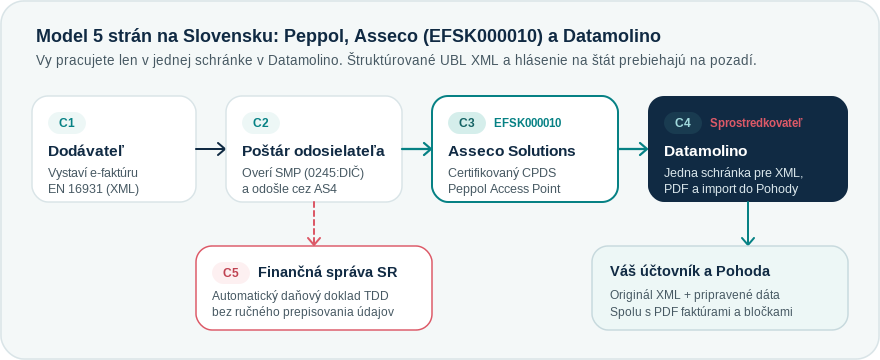
The Financial Administration maintains a detailed methodological FAQ (latest version dated 20 November 2026) clarifying real-world edge cases:
Penalties and deadlines: The standard 15-day invoicing deadline stays unchanged. Statutory penalty ceilings under § 85o / Tax Procedure Code reach up to €10,000 (€100,000 for repeated breaches), except immediate correction of obvious mistakes or proven provider outages.
Even after January 2027, businesses in Slovakia will still receive non-Peppol PDF invoices from foreign suppliers (Stripe, Google, Meta, AWS, overseas shops) and paper eKasa receipts up to €400.
Datamolino keeps your Peppol e-invoices, captured PDFs and mobile receipts in one shared inbox with saved coding rules, optional approvals and direct Pohoda handover.
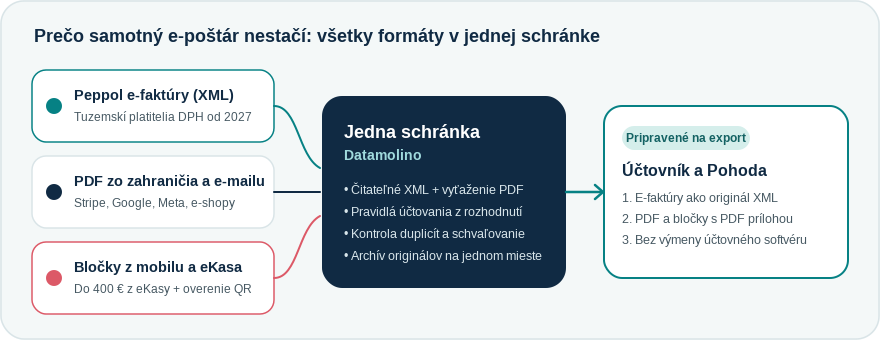
Datamolino s. r. o. is officially registered as a delivery service intermediary with the Slovak Financial Administration via certified provider Asseco Solutions, a.s. Start with a trial and paid plan in Datamolino, or select us directly on the Financial Administration portal and paste the token afterwards.
Registered intermediary
Slovak Financial Administration
No. You can receive e-invoices in Datamolino, read them in plain format, optionally approve them and share the original XML and extracted records with your Slovak accountant or Pohoda.
Cross-border EU B2B e-invoicing and digital reporting under the EU ViDA package are scheduled for 1 July 2030, along with the planned retirement of Slovak VAT control statements (kontrolný výkaz).
Start a 14-day free trial without a card or confirm Datamolino directly on the Financial Administration portal.